Campus Host — the school ERP we built, run and answer for
A multi-school platform for fees, attendance, transport and parent communication — built for 8:40am roll-call and fee-cycle peaks, every school at once.
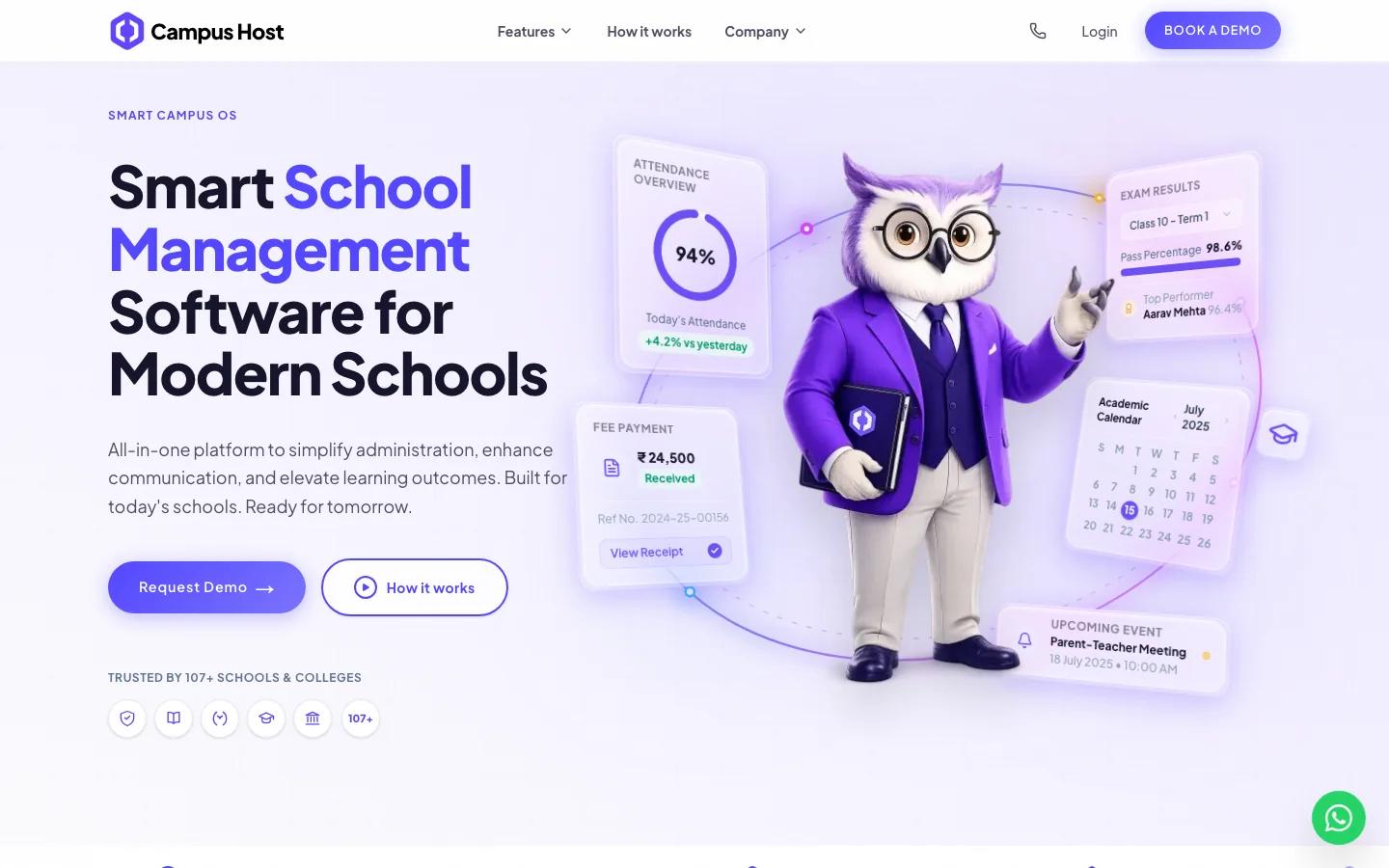
At a glance
13+
Schools running it every day
15,000+
Student records under management
₹1.3Cr+
Fees collected through the system
- Client
- Campus Host — our own product
- Industry
- School ERP · SaaS
- Duration
- Ongoing · live and onboarding
- Location
- India · multi-school
Most of what a school runs on is not teaching
It is a fee ledger someone reconciles by hand, a register that becomes a phone call home three hours too late, a transport roster living in one person's head, and an admission enquiry written on a pad by whoever answered the desk.
Each of those jobs is survivable alone. Together they consume the working day of the people who are supposed to be running the school.
The software sold into this gap fails in one of two ways, and both leave the same residue: a system the office tolerates rather than uses, and parents who still find out about an absence or a fee due at the worst possible moment.
- Option one
A desktop package from 2009
One operator knows how to use it and nobody else can touch it. When they are on leave, the office stops. The data lives on a machine in the corner and leaves the building on a pen drive.
- Option two
A general-purpose ERP
Treats a school like a small factory and expects the school to learn its vocabulary. Bought once, configured by a consultant, then quietly worked around for the next five years.
School software is only ever judged at its worst minute.
The brief we set ourselves
Attendance across every classroom is taken inside the same ten-minute window in the morning. Fee collection does not trickle in — it arrives in a wall on the last two days of a cycle, and it arrives from every school on the platform at the same time, because school calendars in a district move together.
A system that feels quick at noon on a Wednesday can be unusable at 8:40am on a Monday. The second experience is the only one anybody remembers.
So the brief was: one platform covering the whole administrative surface of a school, that a non-technical office can operate, and that treats the peak as the normal case rather than as an exception.
One system, because the value is in the joins
An attendance mark is only worth taking if it can reach a parent. A fee is only worth recording if the reminder goes out on its own. Six modules that would be six separate products anywhere else.
Admissions
Enquiries and the admission process handled in the system rather than on a pad, so a prospective parent is followed up rather than remembered.
Fee management
Fee structures, ledgers, receipts and outstanding balances, with collection recorded against the student rather than reconciled later against a bank statement.
Attendance
Daily roll-call per class, taken quickly enough that it actually happens every day rather than in retrospect on Friday afternoon.
Transport
Routes, vehicles and the students assigned to them, kept as live data instead of a printed sheet taped inside a cupboard door.
Reports
The numbers a principal is asked for — collection, dues, attendance patterns — without somebody assembling a spreadsheet first.
Parent communication
Presence, absence, fee dues and reminders go out over WhatsApp automatically. Not an email nobody opens. The channel the parent is already reading.
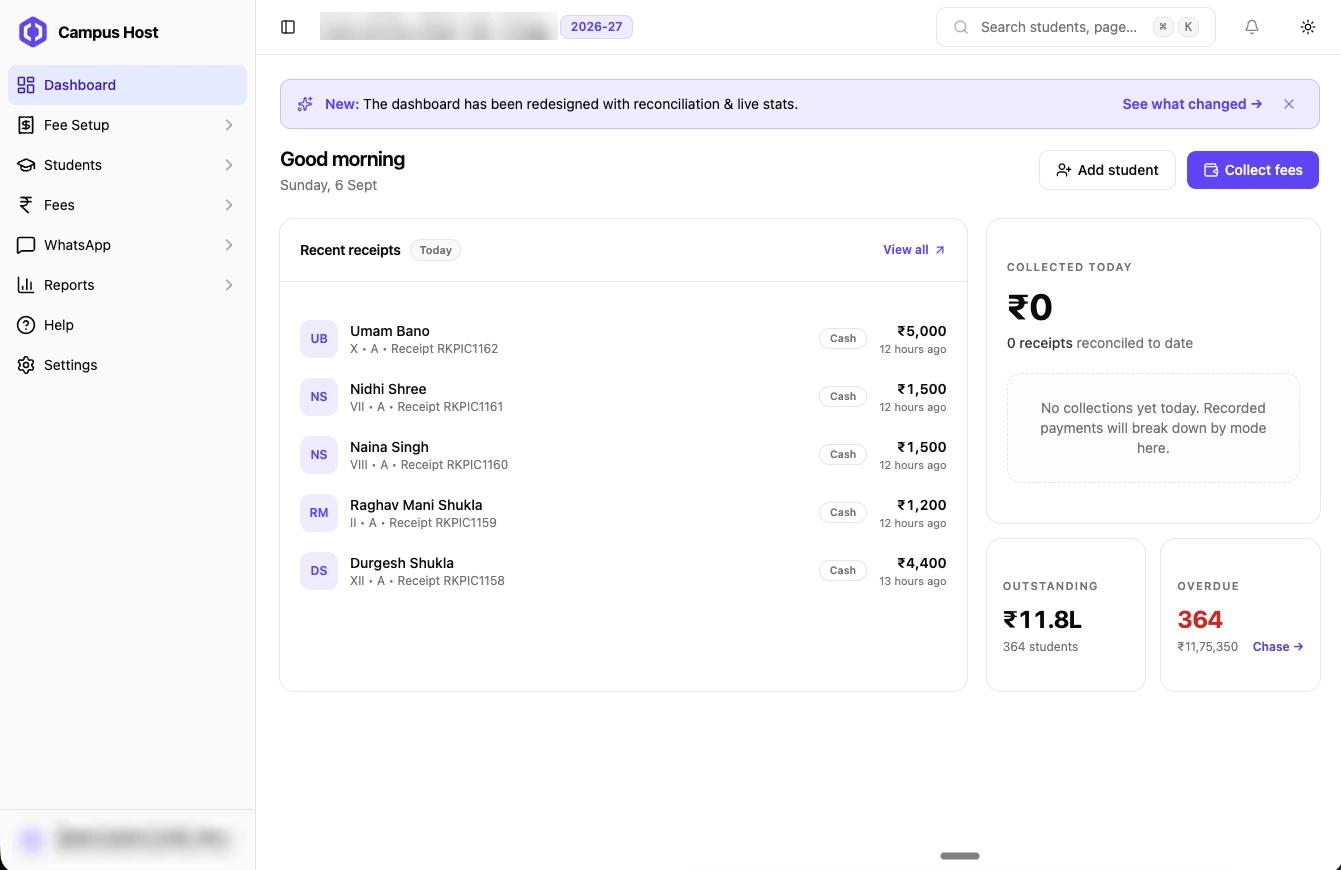
The screen an office actually spends its day in
Not a concept render. This is the live dashboard from a school running Campus Host, with the school's identity removed.
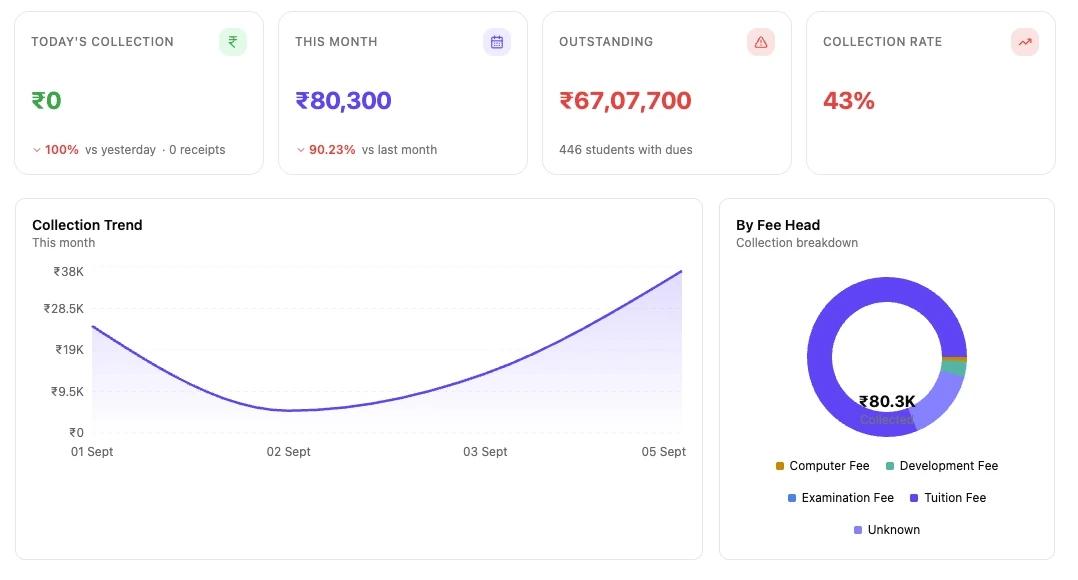
Reporting a principal can read without calling a meeting
Collection trend over the month, a breakdown by fee head, class-wise dues with a drill-down to the individual student.
The reports exist because the alternative is an office manager rebuilding the same spreadsheet every time a management committee asks a question.
Collection rate sits on the front page on purpose. A school ERP that hides the uncomfortable number is a school ERP nobody uses to make a decision.
The hard part was scale, not features
Everything above is a specification. Anyone can put “fee management” on a page. The question is whether the fee page loads on the last day of the cycle.
The platform is multi-tenant: many schools, one system. That is exactly what makes the load spiky rather than smooth. Every school's morning is the same morning. Every school's fee deadline lands in the same week.
The naive version of this product works beautifully with three schools and falls over at thirteen — and it falls over precisely when it is most visible, during roll-call, in front of every teacher at once.
- Vertically
Do more with the same machine
Tuning the query paths, the write patterns and the hot operations that the morning window hammers hardest, so a single instance absorbs far more load than it did.
- Horizontally
Add capacity as schools arrive
Spreading that load across more capacity as more schools come on, instead of asking one machine to absorb a peak that grows with every school we onboard.
This is the part of Campus Host we are most willing to be judged on. It is also the part no screenshot can show you — which is why it is written down here instead.
Where the parent side actually happens
Almost nobody meets a school platform on a 1440px desktop. Parents meet it on a phone, in a WhatsApp thread, in the ninety seconds between two other things.
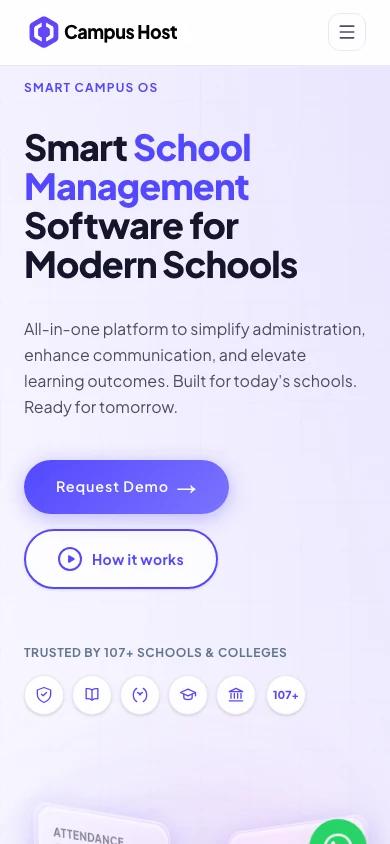
The pitch, on the device schools read it on
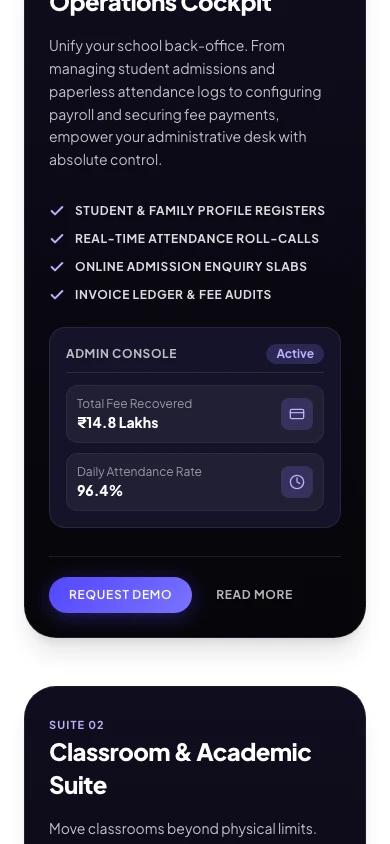
Admin console — fees recovered, attendance rate
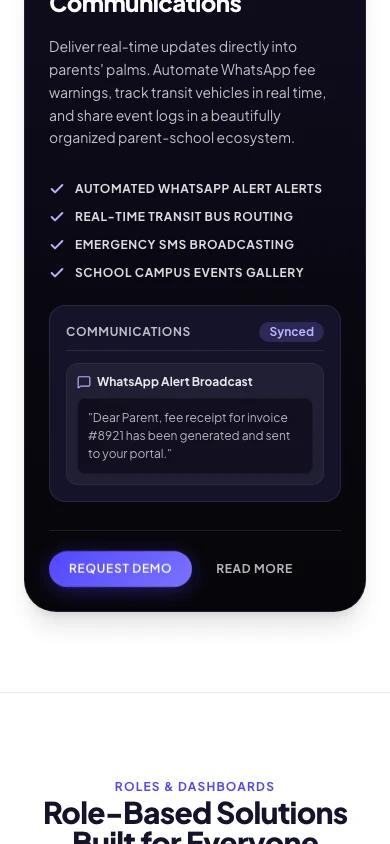
The automated WhatsApp alert a parent receives
Live and in daily use, not a pilot
The commercial model is a per-school subscription. Schools pay for the platform they use, month over month — which means the product only keeps its customers for as long as it keeps working.
That is a harder discipline than a one-off build, and it is the discipline we would recommend to anyone commissioning software for an institution. A vendor who has already been paid in full has no reason to answer the phone in March.
- 13+ schools running the platform every day, with more onboarding — the number is going up, not settled.
- 15,000+ student records under management across those schools.
- ₹1.3 crore+ in fees collected through the system.
- Automated parent communication over WhatsApp for attendance, fee dues and reminders, running without office intervention.
We have been on the other side of the handover
We could have kept selling school websites. A website answers the question a parent asks before they visit. It does nothing for the ninety minutes a day the office loses to a ledger.
Building the ERP meant taking on a different kind of responsibility: uptime, data that cannot be lost, money that must reconcile, and a support expectation that does not end at handover. It also gave us something no agency portfolio can claim by shipping brochure sites — a system thousands of people depend on daily, and the scaling scars that come with it.
That is why our school and hospital work looks the way it does. When we argue about a database schema or a load pattern on your project, it is not theory.
We will run it against your own fee structure and class list, not a demo dataset.