Rama Krishna Public Inter College
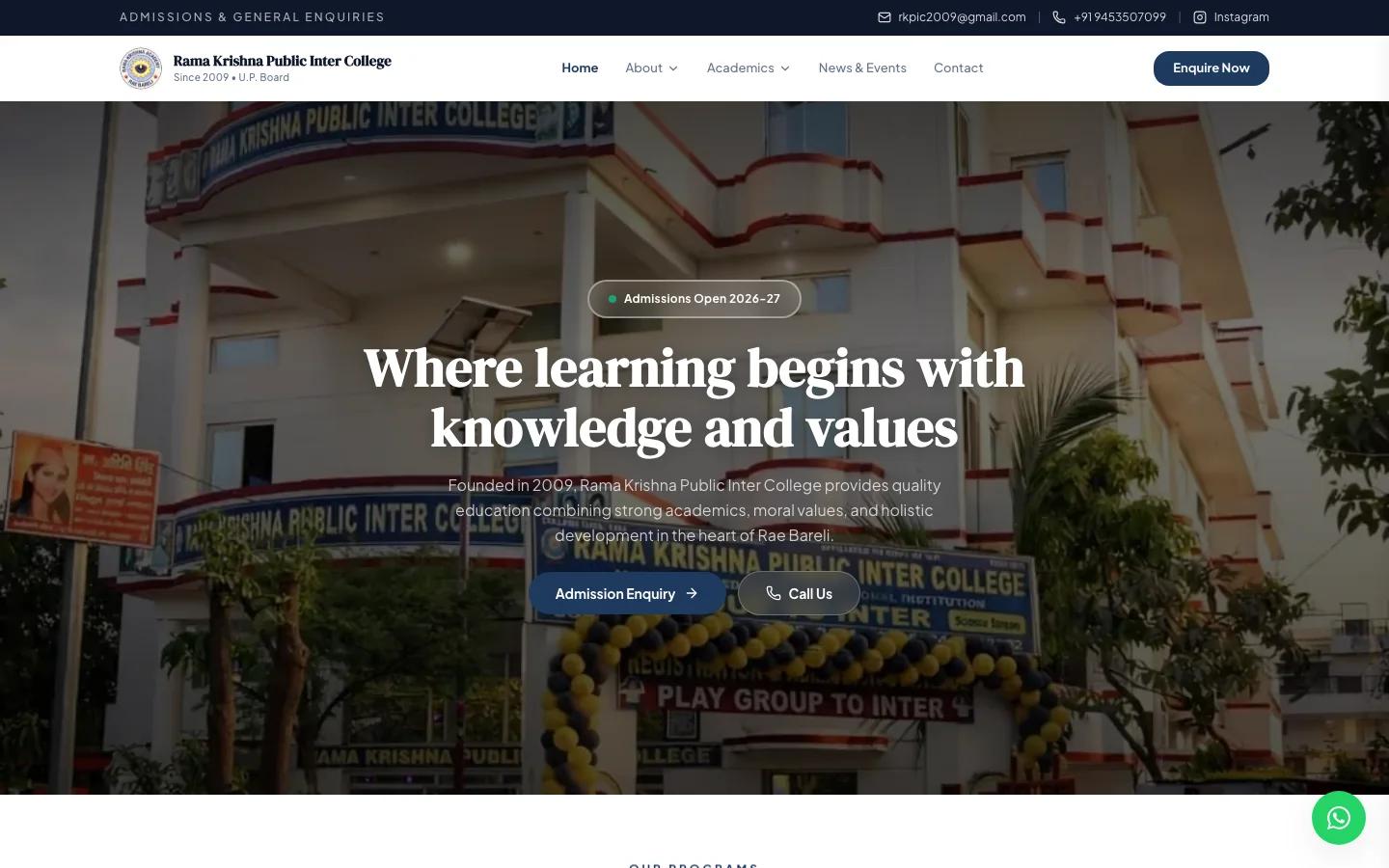
The school had no website at all, so admissions enquiries came by phone and got lost. They now arrive as forms, straight to the office WhatsApp.
99
Lighthouse speed score
Loading...
We build custom Next.js websites and web apps for founders and growing brands. Every project is quoted after a short call, and ships with a 95+ Lighthouse score, your own code, and 30 days of free fixes.

Live, not concepts. Two we are happy to be judged on.

The school had no website at all, so admissions enquiries came by phone and got lost. They now arrive as forms, straight to the office WhatsApp.
99
Lighthouse speed score

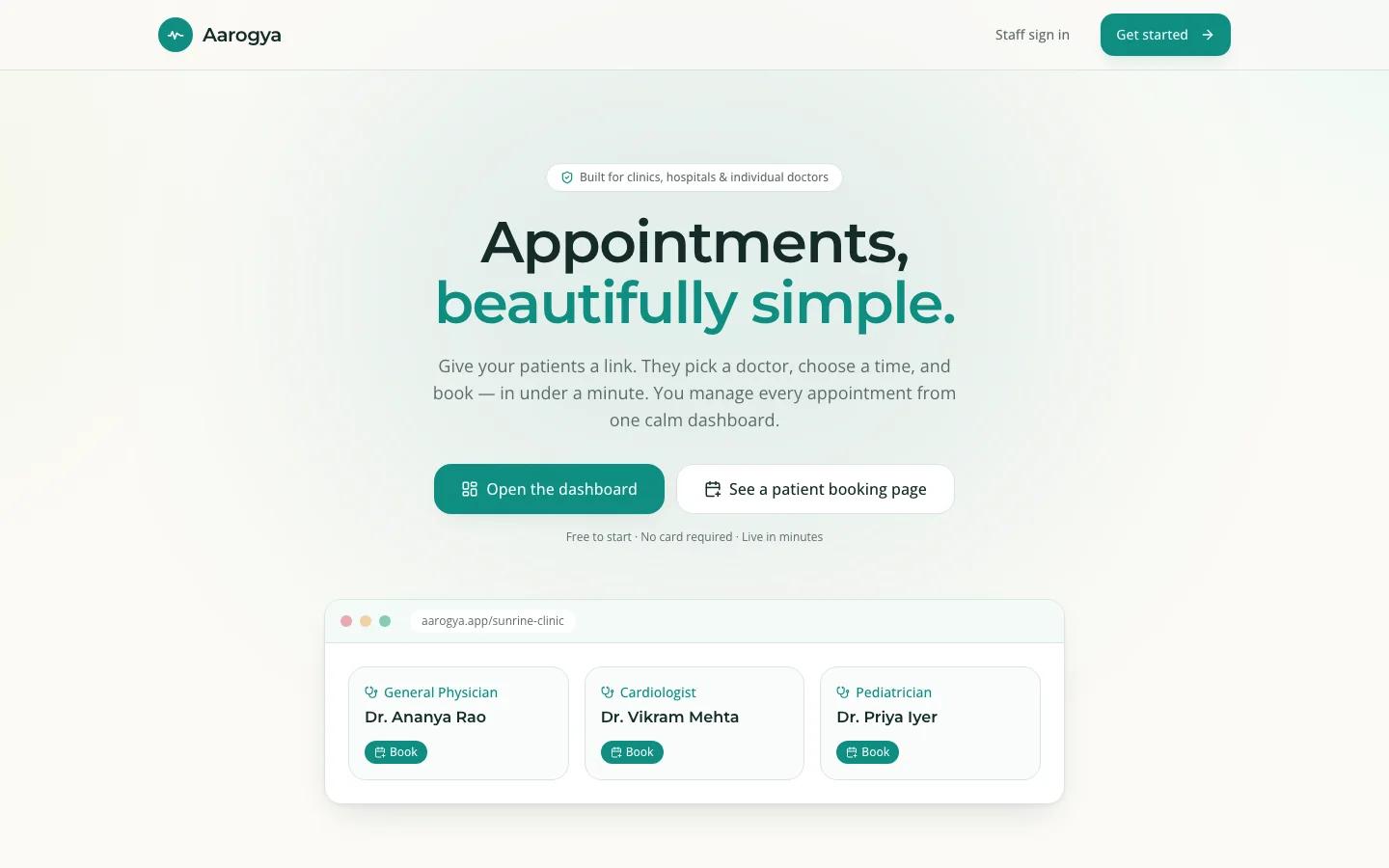
Mornings at the registration desk were a crowd. Intake, the doctor queue, prescriptions and billing now run online, each role seeing only what it should.
5,000+
Patients registered
Web development is building the site or app your business runs on — the pages people find you through, and the screens your team works in. Most work is one of these four.
The site people land on after they search for you. Pages you can edit yourself, forms that reach your inbox and your phone, and a structure search engines understand.
Dashboards, portals, internal tools. People sign in, see their own data and do their job. Roles and permissions from day one, not bolted on afterwards.
Product pages, cart, payment, order emails. Built so a sale never fails because checkout was slow — and so you can add a product without calling anyone.
Same content, same web addresses, new foundation. Every link keeps working, so your search rankings come across instead of starting from zero.
Every project is quoted after we understand it — scope, screens, integrations. Tell us what you need and you get one fixed price before any work starts.
Scope decides the price, so we quote after a short call. Care plans are available once you launch.
Three stages, whatever the size of the project. Here is what happens in each, and what you have at the end of it.
Stage 1
We look at what you have, agree what the site must achieve, and write down what's in and what's out. You get a fixed price before anything is designed.
Stage 2
Grey boxes first, so page order is cheap to argue about. Then the real thing in your colours and type — one direction refined with you, not three to choose between.
Stage 3
From day one there's a private link you can open on your own phone and watch it grow. Checked on real phones, domain connected, every login handed over. Then 30 days of free fixes.
Agreed before we start and written down. No hourly billing, no surprise invoice at the end.
A private link from week one. You never wait until the end to find out what you're getting.
No account manager relaying messages. You speak to whoever is writing the code.
Code, hosting, logins, domain. Handed over at launch. You're free to leave whenever you like.
Common, well-documented tools — so anyone can pick it up after us.
Wondering whether you need Next.js at all? Next.js or WordPress — the honest comparison
Custom web development in India typically ranges from ₹1.5L–₹15L+ ($2k–$80k+) depending on scope.
A polished marketing site with CMS sits around ₹2L–₹6L ($2.5k–$8k). A custom Next.js application — auth, dashboard, integrations — usually lands between ₹12L–₹65L ($15k–$80k). SaaS platforms or AI-powered apps run higher, ₹40L–₹2.5Cr+ ($50k–$300k+). We quote in INR or USD depending on where you are, with transparent line items — design, development, integrations, deployment — so you know exactly what you're paying for. Every estimate ties to a fixed scope and timeline, with optional retainers for ongoing work after launch.
Timelines depend on complexity, but realistic ranges: a marketing site with custom design ships in 4–6 weeks, a custom web application with auth and a dashboard in 8–14 weeks, and a SaaS or AI platform in 12–24 weeks.
We work in two-week sprints with weekly reviews and a staging environment from week one, so you see progress continuously. Discovery and design happen in parallel — we don't wait for one to finish before starting the other. Most delays come from late content, late stakeholder feedback, or scope creep, which is why we lock scope before kickoff and assign a single decision-maker on your side. We hit our quoted dates on 9 of 10 projects.
Pick Next.js when you need real product behavior — authentication, dashboards, custom workflows, AI features, real-time data, or mobile-app-like performance. Pick WordPress when content velocity matters more than custom interaction — a blog-heavy site where non-technical editors publish daily.
For most growth-stage businesses targeting global clients, Next.js is the better long-term bet: it's faster on Core Web Vitals, easier to extend, and renders cleanly for AI agents and search crawlers. WordPress carries a bigger maintenance and security tax, especially with plugins. We build both, but our default recommendation for new projects is Next.js plus a headless CMS (Sanity, Contentful, or Payload) when editors need a CMS layer.
Yes — roughly 60% of our work is for clients outside India, mostly the US, UK, UAE, Singapore, and Australia.
We quote in USD or local currency, sign on Stripe or wire, and run async-first with overlap windows in your time zone. Communication runs through Slack, Linear, Notion, or whatever your team uses. We sign mutual NDAs, IP-assignment clauses, and DPAs when GDPR or HIPAA is in scope. Past international clients include US D2C brands, UK SaaS startups, UAE healthcare networks, and Singapore fintech teams. References available on request. For US/EU clients we typically work US-evening / India-morning overlap, which gets you 4 hours of live collaboration daily.

Default stack: Next.js (App Router) + TypeScript + Tailwind CSS + shadcn/ui on the frontend; Node.js, Postgres, Prisma, and Redis on the backend; Vercel or AWS for hosting; Better Auth or Clerk for auth; Stripe for payments; and Sanity, Payload, or a headless CMS for editor-driven content.
We pick this stack because it's fast to build with, fast to run, well-documented, and large enough to hire for. For AI features we add OpenAI, Anthropic, LangChain, and pgvector. We deviate when a client has an existing stack that works — we won't force a rewrite if your team is shipping on Rails, Django, or .NET.
Post-launch we offer three options.
Free 30-day window: bug fixes and small tweaks at no charge so the site stabilises in production. Care plan retainer: monthly maintenance covering security patches, dependency updates, monitoring, performance audits, content updates, and 4–10 hours of dev time, starting at ₹40k/month. Project-based engagements: new features, A/B tests, redesigns, billed by sprint. Every site ships with monitoring (Sentry, Vercel Analytics, or your tool of choice), automated backups, and a runbook for your team. We hand over full source, infra credentials, and documentation — you own everything. About 70% of clients stay on a retainer because shipping continuously beats yearly redesigns.
Design is collaborative, not waterfall.
Week 1: discovery — we audit your existing site, talk to 2–3 customers, and define success metrics with you. Week 2: information architecture and wireframes for the key flows. Week 3: visual direction — two concepts, then refinement on the chosen one. Week 4 onward: full design in Figma, with a working prototype reviewed weekly. We design in close partnership with development, so design tokens, components, and motion specs translate directly into code with no fidelity loss. Every design decision ties to a measurable outcome — conversion, engagement, retention — not opinion. We use Figma, FigJam, and Loom for async reviews.
Yes. Most of our work starts as a redesign or replatform.
We begin with an audit — performance, SEO, conversion, accessibility, and code quality — then map content and traffic so nothing valuable gets lost in migration. Common paths: WordPress to Next.js (faster, cheaper to maintain), Webflow to Next.js (more control, custom logic), legacy custom builds to a modern stack. We preserve URLs and 301-redirect anything that changes, so search rankings transfer. Migrations typically take 6–12 weeks, with the new site running in parallel for QA before cutover. SEO usually improves measurably within 60–90 days post-launch because Core Web Vitals and structured data are dramatically better.
Yes — Next.js is built for SEO in ways older React setups aren't: pages render as full HTML by default, so search engines and AI crawlers see real content immediately instead of waiting on JavaScript to fill an empty page.
The App Router gives you direct control over metadata, canonical URLs, sitemaps, and structured data on every route, and built-in image and font optimization help the Core Web Vitals scores that Google factors into ranking. We build every site to 95+ on Lighthouse for this reason. For the fuller comparison against WordPress — including where WordPress still has an edge — see our Next.js vs WordPress breakdown at /compare/nextjs-vs-wordpress.
A website mainly displays information — pages, content, contact details — for visitors to read. A web application lets logged-in users do something: manage data, complete a task, or interact with their own account inside the product.
A marketing website is what most businesses need first: pages that explain who you are and get someone to contact you. A web application adds accounts, roles, dashboards, and logic — the kind of thing you'd build for a portal, an internal tool, or a SaaS product. The two aren't mutually exclusive; plenty of projects start as a marketing site and grow a logged-in application on top of it once there's a real need for one. We build both, and during discovery we help you work out which one your business actually needs before quoting.
Longer reads on cost, platform choice, and when a rebuild pays for itself.
Pricing
Website prices in India range from ₹5,000 to ₹10,00,000+. Here is what drives that gap, what each budget tier delivers, and how to avoid getting burned.
Read articleTechnology
WordPress is easy to manage. Next.js is built for performance. Here is which platform builds a competitive advantage — and where each one becomes a liability.
Read articleBusiness
Most redesigns lose money because they are decided on aesthetics, not data. Here is how to calculate whether a website redesign will return more than it costs.
Read articleBusiness
Before you sign anything, ask these 15 questions. They separate agencies that ship from agencies that ghost — and save you 6–12 months of wasted roadmap.
Read articleSend us your current site. We'll tell you what's slowing it down and what we'd do about it — free, and with nothing to sign.
Get started