01
Speed, on a real phone
- Product page load on 4G
- Image weight and format
- Apps loading on every page
- Core Web Vitals, mobile
Loading...
Themes, migrations, and the commerce logic a template cannot build alone — for stores that already sell.

Free, before any money is discussed. You get it written up whether or not you hire us — and every one of these is something you can go and verify yourself afterwards.
No obligation, and nothing to sign.
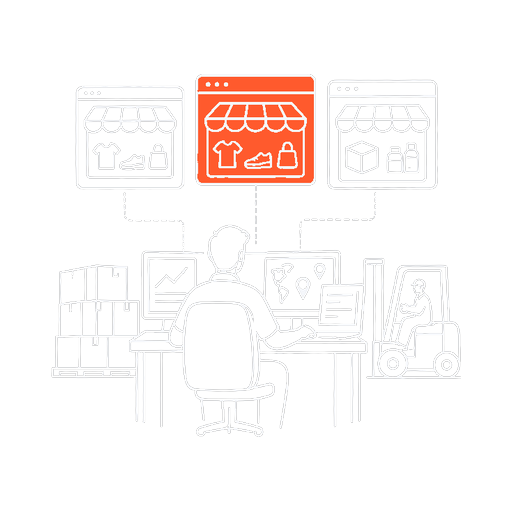
Shopify development is everything between the platform and your customer — the storefront they buy through, and the rules your business actually runs on. Most work is one of these four.
Built on Shopify's own sections and blocks, so your team can change a page without opening a ticket. Designed around your products and your catalogue, not around a template's demo photos.
From WooCommerce, Magento, Wix or a custom cart. Products, variants, customers and order history come across, and every old link redirects — so the search rankings you already paid for come with you.
Bundles, subscriptions, wholesale pricing, product configurators. The rules your business runs on, built properly as an app instead of stitched together from five overlapping plugins.
Custom checkout, several storefronts under one roof, wholesale portals, ERP and 3PL sync. For stores where the platform is the limit, not the design.
Three stages, whether we are building new or moving you across. Nothing touches your live store until you have signed off on the replacement.
Stage 1
Your catalogue, your analytics and your checkout, on a real phone. We write down what is losing sales, what a move would involve, and what is genuinely not worth changing. You get a fixed price before anything is designed.
Stage 2
A real Shopify store with your real products in it, private to you. You click through the whole thing on your own phone while it is being built — not at the end, when changing it is expensive.
Stage 3
Redirects mapped from every old address, payments tested with real cards, orders arriving where your team expects them. We cut over when your traffic is lowest and watch it closely afterwards. Then 30 days of free fixes.
What a store costs depends on your catalogue, your checkout and what has to be rebuilt. Tell us what you have and you get one fixed price before any work starts.
Scope decides the price, so we quote after a short call. Website maintenance is available once you are live.
Agreed before we start and written down. No hourly billing, no surprise invoice when the catalogue turns out to be bigger than it looked.
Every old address mapped and redirected before we cut over. A migration should never cost you the search traffic you already paid for.
A private store from the first week, with your real products in it. Nothing about your public store changes until you have said yes to the replacement.
Standard Shopify architecture, no framework only we understand. Any Shopify developer can pick it up after us — including one who is not us.
Shopify-native where Shopify is good, and ordinary well-documented tools everywhere else.
Not sure Shopify is the right platform at all? Shopify or WooCommerce — the honest comparison
Shopify project costs vary widely. A starter store on a polished theme with 20–40 products usually costs ₹1.5L–₹4L$2k–$5k USD. A custom-themed store with bespoke design, structured product data, and conversion optimization runs ₹4L–₹12L$5k–$15k USD. Shopify Plus builds with custom apps, B2B portals, or headless storefronts on Hydrogen sit at ₹12L–₹40L+$15k–$50k+ USD. Migrations from WooCommerce or Magento land between ₹3L–₹15L$3.5k–$20k USD. We quote per project, not hourly, with transparent line items and fixed delivery dates. Ongoing retainers start at ₹35k$600 USD/month for theme updates, A/B tests, and conversion work after launch. Pricing is in INR for India and USD for international clients.
Our Shopify Partner application is in progress and we expect verified status soon. Practically, what matters more is what we ship: custom themes from scratch, theme customizations, app development, headless Hydrogen storefronts, B2B and Shopify Plus implementations, and migrations from other platforms. We've worked on 30+ Shopify projects across D2C apparel, beauty, supplements, jewelry, and lifestyle brands. We follow Shopify's theme architecture standards (sections, blocks, JSON templates), pass theme review, and keep custom code maintainable for your in-house team or a future agency to take over. Partner status helps with credibility but doesn't change the build quality — that comes from the engineering team.
Yes — migrations are a meaningful share of our Shopify work. We move products, variants, customers (with password reset triggered), order history, blog posts, redirects, and SEO metadata. We preserve URL structures where possible and 301-redirect everything that changes, so traffic and rankings transfer. Custom logic from your old platform — pricing rules, bundles, subscriptions — gets rebuilt as Shopify apps or theme code, whichever fits better. Typical migration: 6–10 weeks including a redesigned theme, new structured data, and a staging cutover dry run. We test heavily on a Shopify development store, then cut over during a low-traffic window with monitoring in place. Most clients see Lighthouse and SEO scores improve within 30 days.
Yes. We build private apps for single-store needs, custom apps for multi-store merchants, and public apps for distribution on the Shopify App Store. Common app types: subscription billing, product bundling, custom checkout extensions (Shopify Plus), wholesale and B2B portals, ERP/CRM sync, custom shipping logic, and AI-powered product recommendations. App stack is typically Node.js + TypeScript + Polaris (for embedded admin UI) + Shopify CLI + GraphQL Admin API. We follow Shopify's app review and security standards so public apps pass review on first submission. Costs run ₹5L–₹25L$6k–$30k USD for typical custom apps, depending on integration depth and admin UI complexity. We also handle ongoing support and app store optimization.
Shopify Advanced caps out at around 1,000 orders per minute and uses standard checkout. Shopify Plus unlocks higher throughput, scriptable checkout via Checkout Extensibility, B2B/wholesale features, multi-store management (up to 9 expansion stores), priority support, and bigger API limits. The license fee jumps from around $399/month (Advanced) to from $2,300/month (Plus). For most merchants under $2M annual GMV, Advanced is fine. Plus makes sense above $2M–$3M GMV, for B2B-heavy operations, multi-region storefronts, or heavy checkout customization. We build on both — same engineering quality, different platform capabilities. We'll recommend Plus only when the additional capabilities clearly pay for themselves, not for status.
Yes — most of our Shopify clients are D2C brands selling internationally. We've worked with Indian D2C brands shipping globally, US apparel and supplement brands, UK lifestyle labels, and UAE beauty retailers. We handle international setups: multi-currency via Shopify Markets, multi-language, region-based pricing, regional compliance (GST, VAT, US sales tax via TaxJar/Avalara), and localized shipping/payment integrations. We also build for D2C-specific needs: subscription stack (Recharge, Stay AI, Ordergroove), reviews (Yotpo, Stamped), email/SMS (Klaviyo, Postscript), upsell stack (ReConvert, Bold), and analytics (Triple Whale, Northbeam). References from D2C clients available on request.
Yes — separately or as part of a build. Shopify SEO covers technical SEO (canonical tags, structured data, sitemap, Core Web Vitals), content SEO (collection pages, product descriptions, blog hub), and on-store merchandising (filtering, navigation, search). Conversion optimization covers checkout funnel analysis, cart UX, product page redesigns, A/B testing through tools like Convert or Shopify-native A/B tests, and post-purchase upsell. We run a 14-point Shopify audit (free) covering both SEO and CRO before any engagement, so you see what's broken before deciding to engage. Typical CRO retainer: ₹50k–₹1.5L$900–$2.5k USD/month, ₹2L–₹6L$2.5k–$7k USD for one-off rebuilds of high-traffic pages with measurable conversion impact.
Yes — integrations are a significant share of Shopify work for growing brands. Common integrations: ERPs like SAP, NetSuite, Microsoft Dynamics, Zoho, and Tally; CRMs like HubSpot, Salesforce, Pipedrive, and Klaviyo; payment gateways like Razorpay, PayU, Cashfree (for India), Stripe and PayPal (international), and Shop Pay; logistics like Shiprocket, Delhivery, ShipStation, and EasyPost; and warehouse/3PL systems. We build using Shopify's GraphQL Admin API, webhooks for real-time sync, and middleware (Node.js or n8n) when transformations are complex. For one-off integrations we quote ₹2L–₹12L$2.5k–$15k USD per integration depending on data complexity and reliability requirements (retry logic, error handling, dashboards).
Yes — Shopify works well for Indian businesses. Rupee pricing, local payment gateways, and compliant invoicing are all standard on the platform, not workarounds you have to bolt on yourself, and checkout matches what Indian shoppers already expect from UPI-first sites.
You can price everything in INR and accept UPI, cards, netbanking, and wallets through Razorpay or Cashfree at checkout. GST-compliant invoices generate through apps like ClearTax GST or Refrens, and Shopify's shipping and tax settings handle India-specific rules out of the box. We set up Indian payment gateways, GST invoicing, and local shipping partners (Shiprocket, Delhivery) as standard on every India-facing build, alongside international payment options if you also sell abroad.
Yes — we build fully custom Shopify themes from scratch, with your own section library and layouts, rather than starting from a purchased template and reskinning it, when a template can't do what your brand needs.
A custom theme means your own section library, block structure, and page layouts built specifically around your product catalog and brand — not a generic theme with your logo swapped in. We follow Shopify's Online Store 2.0 architecture (JSON templates, reusable sections, app-block compatibility), so merchandisers can rearrange pages themselves without touching code, and the theme still passes Shopify's theme review standards. This suits brands where a marketplace theme is starting to feel like a constraint — awkward product pages, no room for a real brand identity, or a layout the catalog actually needs and can't get. For simpler stores, a well-chosen premium theme with structured customization is often the faster, cheaper route, and we'll tell you honestly when that's the better call.
 Written by Vishwa Vivek Yadav, Founder & CTO · Updated
 Longer reads on store cost, platform choice, and moving a store without losing rankings.
Pricing
Shopify stores in India cost ₹10,000–₹3 lakh$120 – $3.5k USD. Real breakdown: development, platform plans, apps, and payment gateways — and what actually drives ROI.
Read articleShopify
Shopify Payments does not work in India, which changes your fees, taxes, and cash flow. A 2026 guide to gateways, GST, and cash-on-delivery for merchants.
Read articleSend us your store address. We'll go through it on a real phone and tell you what is costing you sales and what we'd do about it — free, and with nothing to sign.
Get started